

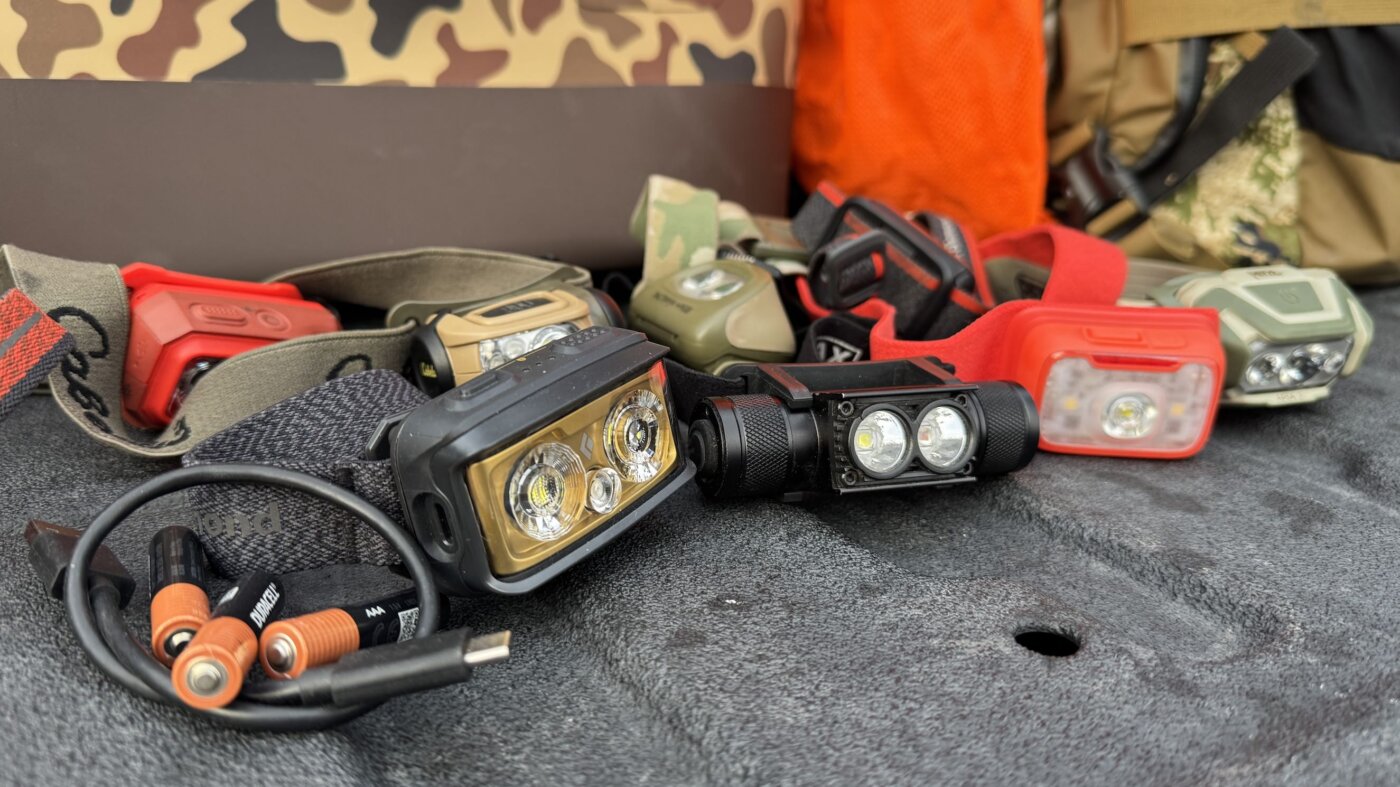
The best headlamps for hunting are bright, waterproof, rugged, and include a red, green or blue light mode. The red, green or blue (RGB) modes will protect a hunter’s night vision while hiking in the dark. Plus, RGB light is far less likely to alert big game animals while you’re hiking to your hunting spot.
Great hunting headlamps also include adjustable beams that pierce through the darkness along a trail but also drop the power to conserve battery. Of course, the main point of having a headlamp for hunting is to give a hunter hands-free light. When I’m quartering a big game animal in the dark, being able to direct light wherever I’m looking is essential.
The best overall headlamp for hunting is the PEAX Backcountry Duo because it’s very bright, easily rechargeable, and has the most powerful red light mode I’ve ever tested — but it’s not perfect. A close second is the Backcountry Storm+ Headlamp because it has all three RGB color options and better light management, making it more versatile for tasks around hunting camp.
The best hunting headlamp bargain is the Coast FLX7 700 Lumen because it has a bright white beam with a handy twist focus that lets you switch from a camp-ready flood to a spotlight beam that’s great for nighttime navigation. Plus, it includes both red and green lights, which is uncommon at its budget-friendly price point.
As you read on, I’ll share my experiences with these headlamps, their best use cases, their battery options, and the kinds of hunters I recommend these headlamps to most often.


How do I know which hunting headlamp is the best? I’m an archery elk hunter and a rifle deer and elk hunter in Idaho where I use and test headlamps in very rough terrain each season. Overall, I’ve personally used and tested more than 50 headlamps over the last decade for hunting, as well as for backpacking, camping, and home repair. I’ve used previous versions of many of these headlamps, and I’m familiar with the manufacturers and their long-term track records of delivering high-quality headlamps. In this buying review guide, I’ll cover the key benefits, drawbacks, and competitive alternatives to help you find out which hunting headlamp is right for you.
- Best Hunting Headlamps
- Best Overall Headlamp for Hunting: PEAX Backcountry Duo
- Best RGB Hunting Headlamp: Black Diamond Storm+
- Best Budget Hunting Headlamp: Coast FL75R
- Most Comfortable: BioLite Range 500
- Best for Hunting Camp: Black Diamond Spot 45o
- Best Battery Choice Bargain: L.L.Bean Trailblazer 700 Rechargeable
- Best with Gloves: Petzl Aria 2R RGB
- Best Made in America: Princeton Tec Vizz 550 RGB
- Best Lightweight Backup: Petzl Swift LT Headlamp
- Best Bargain Cap Light: Browning Night Seeker 2 Cap Light
- How I Test Headlamps for Hunting
- What to Look for in a Hunting Headlamp
- Hunting Headlamp FAQ
- What is the brightest headlamp you can buy?
- Which hunting headlamps are the best overall value?
Best Hunting Headlamps for 2026
The biggest change in hunting headlamps for 2026 and 2027 is a shift toward models that have built-in rechargeable batteries or multi-fuel battery options. For instance, some multi-fuel headlamps come with removable rechargeable battery packs, but they also work with standard alkaline AAA batteries, which makes them more versatile. If you hike into the woods before dawn, you’ll want a headlamp with a red, green or blue mode. And if you hunt in the evening, a bright and dependable headlamp designed for hunting can give you an extra boost of confidence to take your shot right before dark.
As for beam distance and lumens, choosing a high-quality hunting headlamp with good optical components tends to be more important than the exact specs. Higher quality light without shadows, glare, or poor color is what I prefer and recommend for rugged terrain.
Best Overall: PEAX Backcountry Duo
Pros:
- Powerful white beam for rugged terrain
- Very bright red light mode
- Swappable rechargeable battery
Cons:
- Costs more than most
- Heavy
Bottom Line:
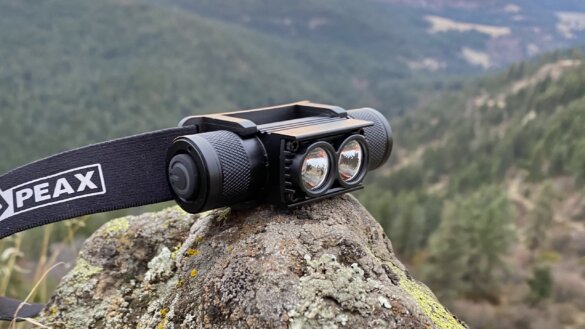
The PEAX Backcountry Duo Headlamp is the best headlamp for backcountry hunters who hunt in steep, potentially dangerous terrain. It blends a reliable, waterproof, rugged aluminum case with a powerful 1,000-lumen white beam and an astoundingly bright red light mode. If you plan to hike into mountains and dense forests in the dark before dawn, and potentially carry out elk or deer in the middle of the night, this is the hunting headlamp you should buy.
Why I like it: The red light mode is amazing — very powerful. While a good red light option might be equivalent to 20-40 lumens, the Backcountry Duo red light mode is astonishing: PEAX says it is equivalent to a 200-lumen white light, and I believe it. Red light and white light aren’t easy to compare, but wow, the Backcountry Duo red light option is very strong. Not only is this safer when you’re trying to pick your path in the dark, it’s useful for hunters. For instance, when I tested the Backcountry Duo on multiple Idaho elk hunts, I could easily identify fresh elk tracks in the dirt in the red light mode. With most other hunting headlamps in their RGB modes, I have to strain to identify details in animal tracks — or kneel down to get a closer look.
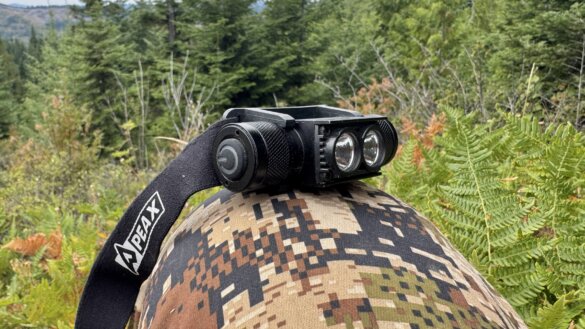
I also appreciate the blend of white light lumen power with the large rechargeable battery system. The downside to running at 1,000 lumens is that you deplete your battery quickly. The Backcountry Duo uses a large 3600 mAh rechargeable battery that can deliver an impressive 6-8 hours of runtime at its highest setting, though it definitely dims after a few hours (which is typical of all headlamps). On the Low output setting, which is equivalent to many smaller, cheaper headlamps, the runtime jumps to 55+ hours. This means that I can use the Backcountry Duo on a lower setting for a long time without fear of running out of battery.
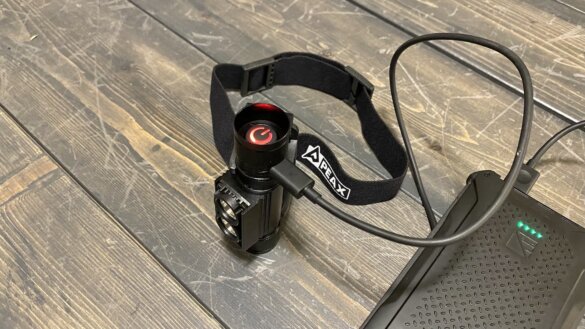
To recharge the 3,600 mAh battery, you simply unscrew one end to reveal a USB-C charging port, which makes it easy to recharge the headlamp in the backcountry with a portable battery bank. So cool. Meanwhile, PEAX sells high-capacity ‘18650’ rechargeable batteries at a reasonable price, so I always carry an extra battery I can swap in on the fly if needed (just like I would carry backup batteries with headlamps that use AAA batteries). If you buy the Backcountry Duo, save yourself some time and hassle and just buy an extra battery at the same time. The price-per-mAh is very competitive.
I was astounded by how well the PEAX Backcountry Duo’s red light mode lit up rough terrain while archery elk hunting in Idaho
What I don’t like: The biggest drawback to the PEAX Backcountry Duo Headlamp is that it is relatively heavy compared to other hunting headlamps. With the battery, it weighs 4.3 ounces. In our experience — read my full Duo Headlamp review for more detail — the PEAX Backcountry Duo isn’t as comfortable to wear for long periods of time compared to lighter headlamps. If you’re sensitive to headlamp weight, consider the ultra-comfortable BioLight Range 500, which I love as a backup headlamp and hunting camp headlamp for cooking.)
Key Specifications:
Max Lumens: 1,000
Max Beam Distance: 149 meters
Color Modes: Red or Green only
Run Time: 6 hrs on high; 16 hrs on medium; 55 hrs on low
Batteries: 1 rechargeable 18650 battery
Waterproof: Yes, IP67 rated
Weight: 4.3 oz (with battery)
Check pricing and availability at:
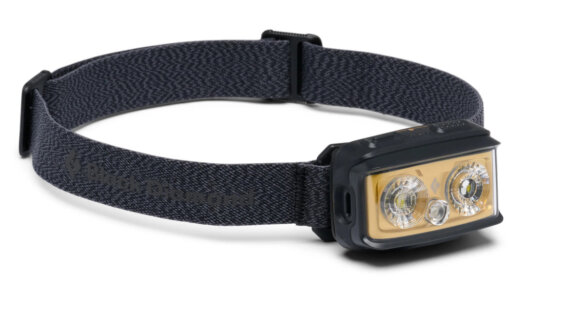
Best RGB Hunting Headlamp: Black Diamond Storm+
Pros:
- Powerful 750-lumen white beam
- RGB modes with awesome green option
- Dual lens optics for high-quality illumination, close and far
Cons:
- Bit spendy
- Can’t replace internal rechargeable battery in the field
Bottom Line:
The Black Diamond Storm+ is the best hunting headlamp with all three red, green, and blue night vision color light modes. It has excellent overall optical quality and usability. Its diffuse lens floods a close-up area with smooth light, making it easy to see, pack, and adjust hunting gear. For distance, its 750-lumen spot beam pierces through dense forests like a lighthouse punches through fog, reaching out up to 149 meters to help hunters navigate in difficult terrain.
Why I like it: For use around camp or organizing gear in the morning before heading out into the woods, the flood light lens mode, which is also called the “Onsight lens”, lets me pack gear without harsh bright spots and glare. It’s just very nice. When it’s time to navigate a trail, a button press gives me full spotlight power and I can run both lenses at the same time, providing illumination that creates glare-free light with better trail coverage.
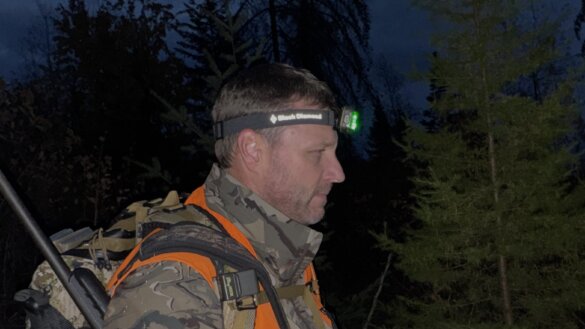
While the red light mode pales in comparison to the red-light Peax Backcountry Duo, the green light mode on the Storm+ is so bright it competes very well. It is so good it essentially erases the red light advantage of the Peax Backcountry Duo. I could easily fight my way through brushy hillsides before dawn using the green light mode on the Storm+. I was very confident in annoying terrain when using the green light mode.
There is another cool feature that makes this headlamp more versatile on long dark nights: Pass-through charging. I can plug this into a portable battery bank to power the headlamp while it’s on my head, giving me extra battery power and confidence to keep using the Storm+ on its brightest setting.
What I don’t like: The biggest drawback to the Black Diamond Storm+ is its lack of removable batteries. The only way to recharge it in the field is to use a battery bank.
Key Specifications:
Max Lumens: 750
Max Beam Distance: 149 meters
Color Modes: Red, Green, Blue
Run Time: 4.5 hrs on high; 20 hrs on medium; 80 hrs on low
Batteries: Built-in 2200 mAh Li-on rechargeable
Waterproof: Yes, IP67 rated
Weight: 4.0 oz
Check pricing and availability at:
Amazon | REI | Bass Pro Shops
_____________________________
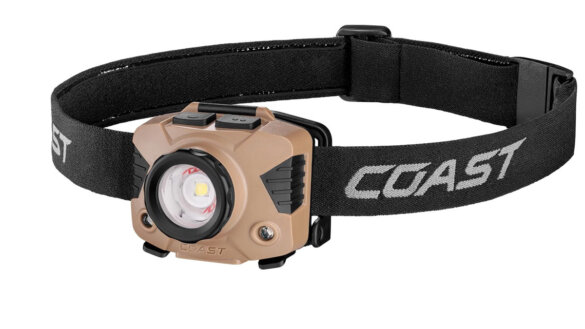
Best Budget Hunting Headlamp: Coast FLX7
Pros:
- Outstanding price-to-value ratio
- Powerful 700-lumen white beam
- Twist-adjustable beam from flood to spotlight
- Includes red and green modes
Cons:
- Bulky
- IP54 water-resistant only
Bottom Line:
The Coast FLX7 is my favorite budget-friendly bargain headlamp for hunting because it’s surprisingly powerful and versatile for the low price. The twist-focus beam pattern is handy and doesn’t require a bunch of annoying button pressing to use. Plus, the green light option is great for navigation in the dark, making this safer than most cheap headlamps that provide weaker red lights.
Why I like it: For many hunting tasks, I just don’t need a premium headlamp. For hunting areas I’m very familiar with, are close to the pickup or UTV, or where the terrain is gentle, I like a simple, inexpensive option. I also love Coast’s PURE BEAM Twist Focus optic system because it’s so easy to use.
I can twist it for a quick look at a critter in the brush far away or twist it to flood mode to make it easier to find gear packed in the back of my pickup. If you want to use rechargeable batteries and upgrade this headlamp, Coast makes some impressive 1.5v ZITHION-X USB-C Rechargeable Batteries. (Most rechargeable AAA options are 1.2v, which means they sometimes stop working in some electronics that were designed for typical alkaline disposable batteries.)
What I don’t like: I wish it were fully waterproof rather than just water-resistant. You can likely use it in the rain without much worry, but I would wear it underneath the bill of a hunting cap to shield it from heavy rain.
Key Specifications:
Max Lumens: 700
Max Beam Distance: 147 meters
Color Modes: Red and Green
Run Time: 2.75 hrs on high; 5.5 hrs on medium; 17 hrs on low
Batteries: 3 x AAA
Weight: 3.74 oz (with batteries)
Check pricing and availability at:
_____________________________
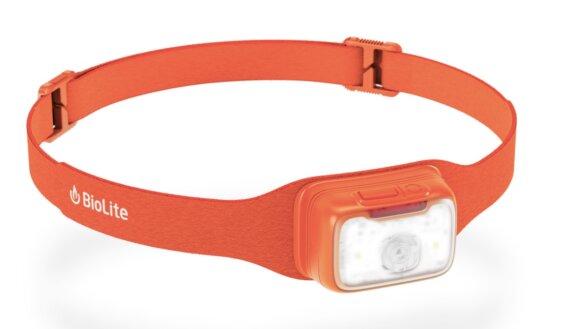
Most Comfortable Hunting Headlamp: BioLite Range 500
Pros:
- Most comfortable band
- Modern, super-fast recharging via USB-C
- Outstanding optical quality
Cons:
- Mediocre red light brightness
- No pass-through run mode
Bottom Line:
Some people can get headaches from wearing heavier headlamps. If that’s the case for you, the BioLite Range 500 is the most comfortable headlamp I’ve worn in a long time. The seamless band is very slightly curved and feels great on bare skin even after hours. Better yet, the 550 lumens offers a crisp, bright beam that’s plenty bright for dark forest navigation in most hunting situations.
Why I like it: BioLite has been making high-quality rechargeable headlamps for years, but most of the previous models had small, hard-to-press buttons. This new version has a much more user-friendly button, so thank you BioLite, we appreciate you. Better yet, the Range 500 uses modern fast-charging USB-C protocols that let me charge this headlamp much faster than other USB-C headlamps. It charges fastest when the battery is mostly empty to around half-full, but get this: I tested BioLite’s claims of charging for just “8 minutes to get another full hour of bright light” . . . it’s legit. This means I’m far more confident using this headlamp at full power than most headlamps because I know I can give it a boost in the field with a good power bank and not be stuck waiting for it to charge.
What I don’t like: I wish the red light mode was just a bit brighter. It’s plenty bright inside a tent and around hunting camp, but identifying buck tracks in the dark without crouching down is a bit harder than with more powerful competitors or green lights.
Key Specifications:
Max Lumens: 500
Max Beam Distance: 100 meters
Color Modes: Red
Run Time: 6 hrs on high; 200 hrs on low
Batteries: Built-in 1634 mAh Li-Ion battery
Waterproof: Yes, IP67 rated
Weight: 2.6 oz
Check pricing and availability at:
_____________________________
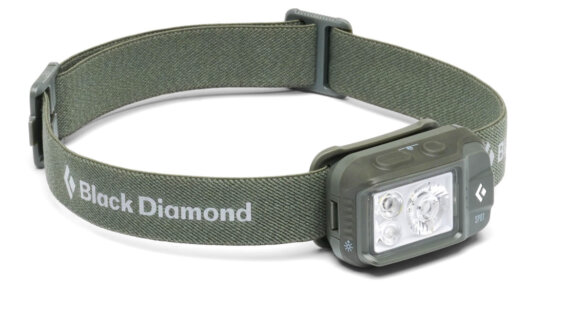
Best for Hunting Camp: Black Diamond Spot
Pros:
- Dual-Fuel battery flexibility
- Red, green, and blue light modes
- Power Tap mode lets you instantly switch to full power
Cons:
- BD 1500 rechargeable battery option sold separately
Bottom Line:
The new for 2026 Black Diamond Spot Headlamp is one of the best all-around midrange headlamps because it blends a lightweight design with decent power. Better it, you can use this headlamp with standard AAA batteries or use the BD 1500 rechargeable battery pack for longer runtimes on high.
Why I like it: The previous Black Diamond Spot 400 was my favorite lightweight backpacking headlamp, but the new 450-lumen Black Diamond Spot is even better. Here’s why: You can now leave the BD 1500 Li-ion battery pack inside the headlamp to charge it via a built-in USB-C port. Previously I had to pack around a separate little charger for it. The other reason I like this headlamp is that I can use the BD 1500 rechargeable pack around camp, burning up battery that I can easily top off as needed. Plus, I like being able to tuck three AAA batteries into the bottom of my hunting pack to keep as an emergency backup in case I do run the battery down.
What I don’t like: I wish the Spot just shipped with a BD 1500 Li-ion battery pack instead of needing to buy it separately. I think we’re beyond the days of preferring alkaline batteries and we’ve shifted to most people having USB-C charging capabilities handy at home, in their vehicles, and with portable power banks.
Key Specifications:
Max Lumens: 450
Max Beam Distance: 116 meters
Color Modes: Red, Green, and Blue
Run Time with AAA: 2.6 hrs on high; 5 hrs on medium; 200 hrs on low
Run Time with BD 1500: 3.4 hrs on high; 8 hrs on medium; 150 hrs on low
Batteries: 3 x AAA or BD 1500 Li-ion rechargeable pack
Waterproofing: Yes, IPX7
Weight: 3.0 oz (with batteries)
Check pricing and availability at:
_____________________________
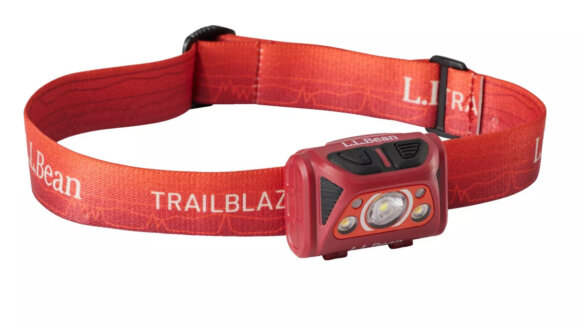
Best Battery Choice Bargain: L.L. Bean Trailblazer 700
Pros:
- Surprisingly powerful for the price
- Ships with rechargeable battery pack
- Also works with AAA batteries
Cons:
- Must remove rechargeable battery to charge it
- Max brightness drops to 590 lumens with AAA batteries
Bottom Line:
The L.L. Bean Trailblazer 700 is a surprisingly powerful and versatile branded headlamp from the maker of the legendary Bean Boots. Unlike many competitors, it’s a multi-fuel capable headlamp that actually ships with an included rechargeable battery pack. It also provides multiple lighting modes to let you fine-tune the beam and intensity you want.
Why I like it: While I always carry a small rechargeable battery bank in my hunting packs to provide emergency power to my phone and InReach satellite communicator — as well as for recharging headlamps — I very much like having an option to bypass all that in favor of using replaceable batteries I an find most anywhere.
What I don’t like: The rechargeable battery pack requires a Micro-USB cord to charge it, which is not included. If you’re like me, you probably have at least one somewhere in your home or garage. I’m trying to transition all my rechargeable gear to USB-C, so this is a minor annoyance.
Interesting side note: The L.L. Bean Trailblazer 700 looks remarkably similar to the Nite Ize Radiant RH2. Legit companies don’t do knockoffs, so the L.L. Bean model is more likely a licensed version, or the two companies share a manufacturer, or they have some other sort of business relationship in place. This is pretty common for big brands.
Key Specifications:
Max Lumens: 700
Color Modes: Red
Run Time with Rechargeable Pack: 1.7 hrs on spot high; 11 hrs on flood high; 18 hrs on flood low
Run Time with AAA: 2.5 hrs on spot high; 17 hrs on flood high; 29 hrs on flood low
Batteries: Included rechargeable battery pack or 3 x AAA
Waterproof: Yes
Weight: 2.65 oz (with AAA)
Check pricing and availability at:
_____________________________
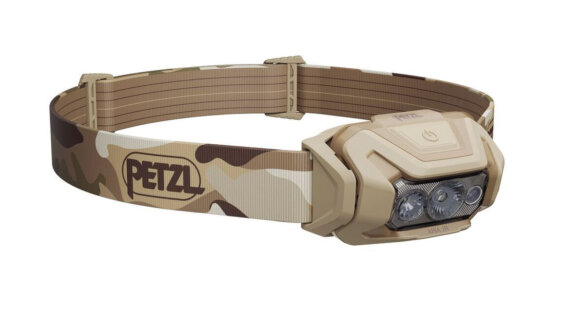
Best With Gloves: Petzl Aria 2R RGB
Pros:
- Large, centered top button easy to find and use
- Comes with rechargeable battery pack
- Also with AAA batteries
Cons:
- Must remove rechargeable battery for charging
Bottom Line:
The Petzl Aria 2R RGB blends high-quality optics with a simple-to-use one-button design that easy to find and press even when wearing gloves in cold weather. The included Petzl CORE rechargeable battery pack can replace hundreds of AAA batteries over its lifetime, and you can charge it with modern USB-C cables.
Why I like it: I’m a fan of headlamps that ship with rechargeable, removable batteries. The 625-lumen beam is plenty powerful for all but the nastiest of forests and mountains, and the RGB modes work well. The tilt-adjusting system feels a bit clunky, but it’s held up remarkably well and it creates stable angles that don’t shift on my head while I’m navigating in the dark. I like running it with both the spot and proximity beams lit at the same time because the blended light pattern makes it easier to see close-up branches and trip hazards while also being able to see farther ahead.
What I don’t like: The battery door is well protected by the frame, but it’s not intuitive to open. I feel like I’m turning the case too far and will break something every time I open it. It’s proven to be durable, but it’s definitely different than most headlamps.
Key Specifications:
Max Lumens: 625
Max Beam Distance: 115 meters
Color Modes: Red, green, and blue
Run Time: 2 hrs on high; 7 hrs on medium; 100 hrs on low
Batteries: 1 rechargeable 1250 mAh CORE battery pack (AAA compatible, too)
Waterproof: Yes, IP67
Weight: 3.4 oz (with battery pack)
Check pricing and availability at:
_____________________________
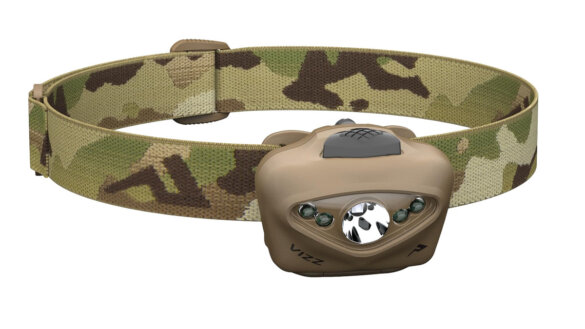
Best Made in America Headlamp: Princeton Tec Vizz 550 RGB
Pros:
- Made in the USA!
- RGB color mode options
- Powerful red light beam mode
Cons:
- Costs more than most
- Heavy
Bottom Line:
The Princeton Tec Vizz 550 RGB is a rugged full-featured Made in the USA headlamp. The optical white light quality is excellent, and the dual-LED red light mode is powerful enough for dense forest navigation at night.
Why I like it: Aside from the chance to support a quality company with a USA-built product, the red light mode is the second brightest and most focused red light mode I’ve used. I could use it to read animal tracks while standing completely upright, so that’s a good indication of its power. I’m also a fan of its awesome battery door locking system — it uses a screw nob to securely seal the door against water and dust.
What I don’t like: It only has a single white spot beam, and while I tend to use spot beam patterns the most, I sometimes prefer to use wide flood pattern beams when I’m working around hunting camp or messing with hunting gear.
Key Specifications:
Max Lumens: 550
Max Beam Distance: 95 meters
Color Modes: Red or Green only
Run Time: 2.5 hrs on high; 16~ hrs on medium dimmed; 75 hrs on low
Batteries: 3 x AAA
Waterproof: Yes, IP67
Weight: 3.6 oz (with batteries)
Check pricing and availability at:
_____________________________
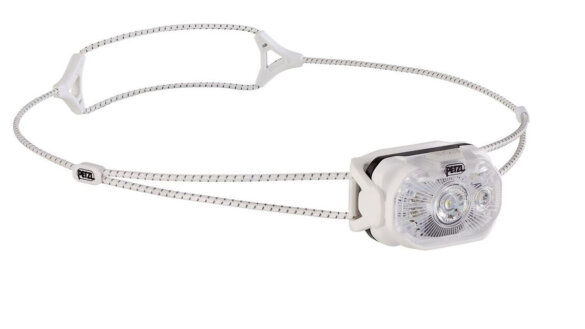
Best Lightweight Backup: Petzl Swift LT Headlamp
Pros:
- Ultralight weight
- Quality white light makes 380-lumens usable
- USB-C rechargeable battery
Cons:
- Can wear in rain but not fully waterproof (IPX4)
- Underpowered
Bottom Line:
The Petzl Swift LT Headlamp is an outstanding ultralight headlamp with a red light mode. While its wide beam-only white mode is underpowered as a primary navigation hunting headlamp, it’s a low-weight backup headlamp that’s good for emergency use. If your more powerful headlamp fails, this 1.5-ounce option won’t weigh you down.
Why I like it: Whenever I head out on evening hunts, I always carry an extra headlamp. If we’re successful, we could potentially need light to locate and process the meat then haul it out. If we’re talking elk, that usually takes hours. Quality headlamps rarely fail, but sometimes things go wrong, and I like knowing that I always have a backup headlamp I can trust — especially if someone gets hurt. The Petzl Swift LT is light enough that I won’t question the extra 1.5 ounces in my pack.
What I don’t: I love the weight but wish it were just a bit more compact.
Key Specifications:
Max Lumens: 380
Max Beam Distance: 70 meters
Color Modes: Red
Run Time: 2 hrs on high; 6 hrs on medium; 60 hrs on low
Batteries: Built-in 880 mAh rechargeable battery
Waterproof: Rain-resistant only, IPX4
Weight: 1.5 oz
Check pricing and availability at:
_____________________________
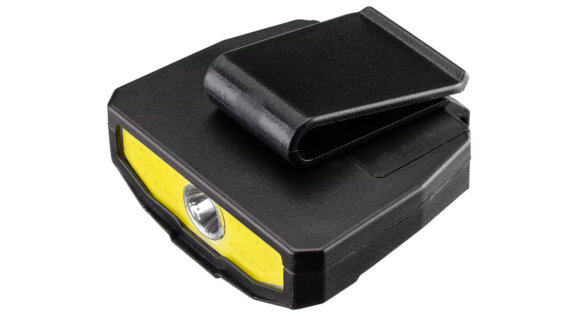
Best Bargain Cap Light: Pursuit 200-Lumen Cap Light
Pros:
- More powerful than many cap lights
- Uses 2 AAA batteries
- Includes both spotlight and wide beam modes
Cons:
- Costs more than most
- Heavy
Bottom Line:
The Bass Pro Shops Pursuit 200-Lumen Cap Light is much more powerful than most cheap cap lights, plus it uses easy-to-find AAA batteries. It’s a handy additional light for hunters, plus it’s packable enough to function as a backup headlamp.
Why I like it: This is a decent backup headlamp, and I like to have one handy for getting ready to go on a hunt in the dark. Cap lights let me spot gear in the back of my pickup easier than without but don’t burn up any precious energy I want to save in the headlamps I take off the trail. Plus, I can’t argue with the price — it’s one of my favorite stocking stuffers for hunters.
What I don’t like: While I most often wear a baseball cap while hunting, sometimes I want a warm stocking cap, in which case the Pursuit 200-Lumen Cap Light doesn’t have a cap to mount to so it becomes just another hand-held flashlight.
Key Specifications:
Max Lumens: 200
Max Beam Distance: 50~ meters
Batteries: 2 x AAA
Check pricing and availability at:
_____________________________
How I Test Headlamps for Hunting
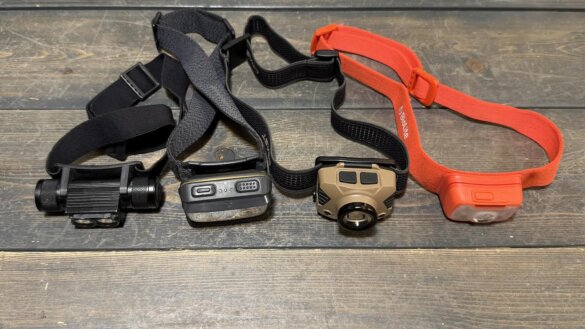
I use the headlamps while hunting: My primary test that matters the most is actually using the hunting headlamp in the field during a hunting situation. This lets me understand not only real-world light and battery performance over rugged terrain and weather conditions, it teases out usability benefits and drawbacks. For instance, you might not realize that 4.3 ounces is a bit heavy on your head if you don’t wear a headlamp that weighs that much for a few hours while hiking in the dark.
Here’s an example: In the dark, I often put the Peax Backcountry Duo on upside down because its uniform shape makes it hard to tell its orientation by feel in the dark. This is problematic with some headlamps but not the Backcountry Duo because its vertical adjustment can go in either direction and the power button is on the side. No harm, no foul.
I evaluate light quality: I’ve also learned that cheap headlamps produce harsh light with lots of glare and sometimes dead spots in the beam pattern. I don’t like using cheap headlamps with poor beam patterns because I’m more likely to trip in rough terrain. On well-used trails it’s not a big deal, but once I’m tired with a heavy load, better light is more likely to get me home safely. I also consider color temperatures and color fidelity by looking at a color wheel using the headlamp’s light to consider color shifting.
In the video above, the 750-lumen Black Diamond Storm+ (rear) was much brighter than the 500-lumen BioLite Range 500 headlamp (front) when running at max brightness.
I consider runtime characteristics: The best hunting headlamps do very well in matching their published runtime specifications, but that leaves a big range in how long they maintain higher lumen output before dropping down to conserve battery. If you aren’t sure about lumen output over time and what the ANSI FL-1 standard for runtimes actually means when headlamp manufacturers report their test results when using it . . . definitely drop down to my easy-to-understand light output explanations in our Hunting Headlamp FAQ below.
I test waterproofing: For appropriately waterproof-rated headlamps, I fully dunk each headlamp with its light on, then look for water ingress or outright failures. For water resistant headlamps, I use them in the rain and/or expose them to falling/splashing water to simulate rainy conditions.
I evaluate button quality and overall durability: Cheap headlamps often use fragile buttons that cause premature failures, so I pay special attention to buttons. I also consider housing designs, rechargeable battery systems, ports, and doors, as well as consider headband and mounting system quality.
What to Look For in a Hunting Headlamp
There are two critical elements to consider when you buy a good hunting headlamp: white light light power and red, green, or blue (RGB) light options.
For white light, 300-500 lumens is usually sufficient for navigation around farmland and relatively flat forests. Once you get into dense forests with steep, rocky ground with lots of trip or fall hazards, 500-lumens is the minimum and 750-1,000 lumens is usually far safer and a better choice.
Red, green, or blue light is critical for early morning hunts where you need to sneak into a hunting area without spooking animals or ruining your night vision. A powerful red light mode makes forest navigation safer. Blue or green light modes are nice options because some people’s eyes are able to see a bit better in dim light if it’s blue or green instead of red.
Because all modern hunting headlamps start out bright then dim to conserve battery, I tend to prefer rechargeable options that make it easy to top-off batteries and keep them more fully charged before each hunt. If you rarely use a headlamp and rarely use a headlamp for more than an hour, rechargeable batteries are less critical or worth spending a bit more to get.
Last of all, I think quality of light is worth considering. Cheap headlamps produce yellowish, dingy light that makes it hard to discern animal tracks and trip hazards. Quality headlamps give you even, glare-free light that makes navigation safer and cooking at hunting camp easier.
Hunting Headlamp FAQ:
How many lumens do I really need for a hunting headlamp?
For most outdoor activities on trails or in the forest, you should get a high-quality LED headlamp rated at 300 lumens or more. Why? You want to have enough light output to help you see uneven ground in the dark. A headlamp with 300 lumens or more can better illuminate rocks, roots, branches and brush that can trip or injure you in the dark. With today’s more efficient LED bulbs and quality electronics, we now typically recommend at least 400 lumen headlamps for hiking, backpacking, camping, and hunting. In addition, for very rugged terrain, we recommend headlamps with 450 or greater lumens that also have high quality light output. To save battery life when using a high-quality, high-lumen headlamp, you can dim the output to best match your lighting needs on the trail.
Why do headlamps get dimmer the longer you use them?
Most headlamps gradually get dimmer as you use them in order to preserve battery life and still produce usable light. For example, your headlamp might say it has a 7-hour runtime on high using an ANSI FL-1 Standard for runtimes, but that is a bit confusing for consumers who choose a new headlamp but then wonder why it gets dimmer as they use it. Basically, the lumen output will decrease over time to conserve battery power and technically give you light for 7 hours. You won’t really get 7 hours of full power output. Manufacturers make choices on how they electronically deliver the power usage compared to the light output, and nearly all hunting headlamps sacrifice some lumen output over time in favor of maintaining some amount of usable light output for as long as possible. Plus, most people, even in rugged terrain, don’t need to run their headlamps at maximum output — but sometimes it’s comforting and handy to do so.
What is the ANSI FL-1 Standard for runtimes?
For practical purposes, the ANSI FL-1 Standard for reporting headlamp and flashlight runtimes is the length of time a headlamp/flashlight will deliver light until the beam’s lumen power is reduced to 10% of its initial output. Nearly all hunting headlamps gradually reduce lumen power over time to conserve battery and keep providing light in, presumably, rugged outdoor situations. If a headlamp tried to maintain a full-power output, it would quickly deplete its lightweight energy supply and go dead — perhaps unexpectedly in a dangerous situation in the dark. Some expensive headlamps with much larger battery packs deliver regulated outputs that prioritize full power over longevity. The drawback to these headlamps is usually increased weight and bulkiness that is not suitable for most hunting situations.
How can I interpret the ANSI FL-1 Standard in hunting headlamp runtimes?
Here is an example of how the ANSI FL-1 Standard can be used to understand headlamp runtimes: If a 500-lumen headlamp has a published runtime of 7 hours on its highest setting, as measured with the ANSI FL-1 Standard for runtimes, by the time the headlamp hits 7 hours of usage, the beam’s lumen power will only be 10% as bright as when it started. In this case, that means the light coming from the 500-lumen headlamp after 7 hours will only be producing 50 lumens of light. At this point, most headlamps for hunting have a bit of reserve power where the headlamp goes into a sort of emergency mode where the output is often reduced even further, often down to .25 Lux at 4 meters, which is considered the amount of light put out by a full moon on a clear night in an open area. This ultra-low power/reserve mode might give you several more hours of weak light output before the battery is completely drained.
The rate at which the lumen power drops over time is not usually published by headlamp manufacturers. What hunters need to know is this: A fully charged headlamp will deliver a very bright beam at full power — or at nearly full power — for a relatively short time. Typically you can get a couple of hours of high-end lumen output before you start noticing that your light is beginning to dim.
In real-world hunting situations, you can usually navigate through rugged terrain with your headlamp on a medium setting, which will greatly extend your overall runtime. We recommend that you save the highest mode for critical needs only — and pack extra batteries or USB battery packs to recharge your headlamp as needed in the field.
What is the brightest headlamp you can buy?
The Ledlenser H21R Headlamp 2026 Edition has a boost mode that delivers an astounding 10,000 lumens, making it one of the brightest headlamps you can buy.
However, you should also know that choosing the “brightest headlamp” is more complicated than the question first seems. Bright headlamps typically only produce a maximum lumen output for a fraction of the headlamp’s total runtime before the headlamp auto-regulates to conserve energy and the batteries expire completely. This means that a headlamp with a 3,000-lumen rating might only run at 3,000 lumens for a few minutes before it drops down to 1,000 lumens or less. In some cases, it might be smarter to choose a 1,000-lumen headlamp that will run with higher output for 2 hours than a 3,000-lumen headlamp that will fade out more quickly.
If that was confusing, this is what you need to know: Very bright headlamps won’t run at maximum brightness levels for long periods of time.
In addition, very bright high-lumen headlamps can run hot. Some are overbuilt (and heavy) to help dissipate heat. If they accidentally turn on inside of a backpack or travel bag, heat buildup can damage the headlamp or surrounding items and materials.
If you’re with other people, very high-output headlamps can be hard on your companion’s eyes if you accidentally look at them and shine your very bright headlamp in their faces.
Still, if you want raw lumen power and maximum brightness, consider these very bright headlamps:
- NEBO Transcend 3000 Headlamp – 3,000 lumens
- Coast XPH34R Headlamp – 2,700 lumens
- Streamlight ProTac 2.0 Ducks Unlimited Headlamp – 2,000 lumens
- Cabela’s CHL 2000 RGB Headlamp – 2,000 lumens
Which hunting headlamps are the best overall value?
The budget-friendly Coast FLX7 700 Lumen is my favorite headlamp for hunting when you’re on a tight budget. The flood mode is good for around hunting camp and the spot mode is decent when navigating home after sunset. The red light is mediocre, but the green light is surprisingly powerful and does a good job of illuminating roots and trip hazards. At around $29 bucks, it’s hard to beat. Add in a cheap 36-pack of Amazon Basics AAA alkaline batteries and most hunters will be good to go for 2-3 seasons.
But that’s not the full story.
In rugged terrain, the Coast FLX7 doesn’t compare to the Peax Backcountry Duo or the Black Diamond Storm+. Both The Backcountry Duo and the Storm+ are fully waterproof and are rechargeable, which means you can recharge them for hundreds of cycles without needing to buy any batteries. That reduces your lifetime cost to run the headlamp, plus it saves you time and effort of buying or shipping batteries. Plus, the overall build quality, lens quality, and ruggedness are easily 3x better, matching the extra cost. If I need to navigate out of any seriously sketchy situations, I want one of these headlamps on my head or on the heads of people I love.
So worth it? Heck yeah. I bought both. Here is how to choose:
- Choose the Black Diamond Storm+ if you want a multipurpose headlamp that’s just as good for barbecuing up a steak at elk camp as it is navigating over deadfalls after an all-day hunt.
- Choose the Peax Backcountry Duo if you need to sneak into scary-steep country and find your way through unfamiliar territory far from the beaten path.
What is the best middle-ground, general-purpose hunting headlamp value?
Man, this is a tough battle between the USA-made Princeton Tech Vizz 550, which has the second-best red light mode I’ver ever tested, and the Black Diamond Spot, which is a lightweight dual-fuel headlamp that I like as a backcountry backup.
If you can get the Tech Vizz 550 for around $50~ then add in a 36-pack of Amazon Basics AAA batteries, you’ll be good to go for years and might not even break $65. The double red LED bulbs are pretty great for early morning sneak-in navigation — or running away from bugling bull elk when legal shooting light ends too quickly.
If you’re willing to go through the hassle of buying the BD 1500 battery pack from Black Diamond, and nab the Spot on sale for around $50, you can end up spending about $75. For me, that means I have a lightweight headlamp that I can wear comfortably for hours, take backpacking, and use around camp without worrying about wasting alkaline batteries. And I can still pack around three shelf-stable alkaline batteries to use as a backup in case I ever need them (which I rarely do). Lots of winning with the Black Diamond Spot.
So, big question: Should you go cheaper? If you don’t hunt in any sort of rugged terrain, if you stay close to your vehicles, and if the weather is always good, you might not need a high-quality headlamp. But I’ll also say this: Once you use a quality headlamp with good optical quality that doesn’t have shadows or glare . . . you’ll probably prefer to avoid the cheap stuff forever after.
