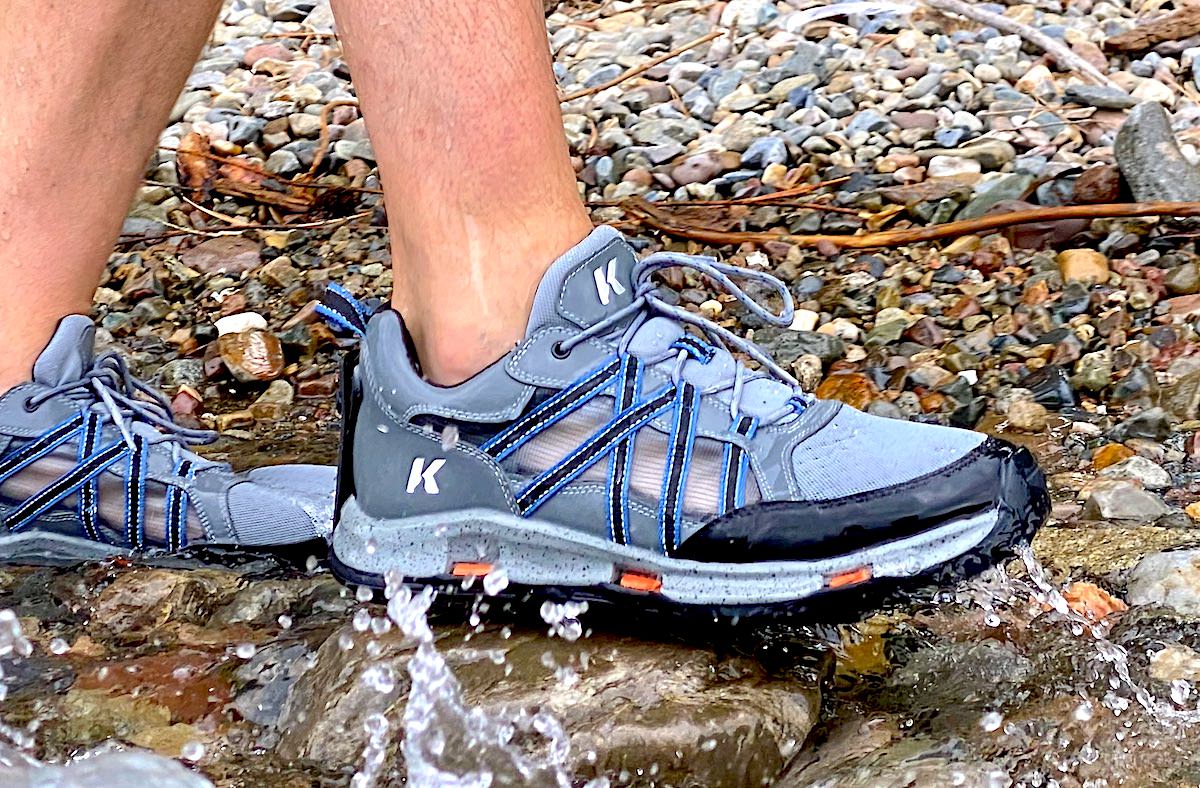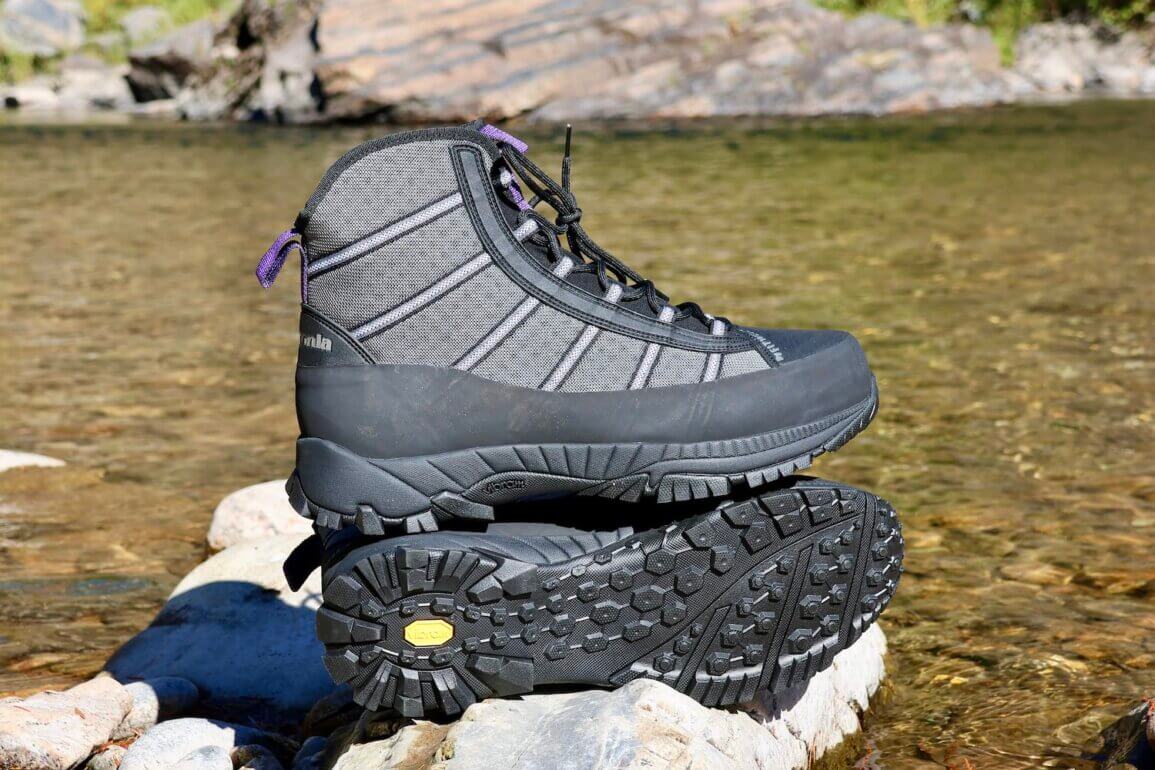
I’m now a fan of lightweight wading boots, pure and simple. Up until five years ago, I used to believe that the burliest, heavy duty wading boot was the best because it would last longer and provide more support. But that’s no longer my experience or my belief. Here are the three key reasons I prefer to wear lightweight wading boots whenever I’m fly fishing in rough terrain:
- I am more agile in lightweight wading boots
- Some lightweight options deliver excellent ankle support
- I get less tired when fishing all-day in lighter wading boots
Skip Down to My Favorite Options and Recommendations
Lightweight Wading Boots Are Great for Rugged Terrain
 It didn’t take long for me to become a fan of lightweight wading boots: The first two pairs I tried were the Simms Flyweight Wading Boots and the Orvis Ultralight Wading Boots. I now choose lightweight options for my all-day hike-and-wade fishing trips. These two models were the first versions to launch the lightweight wading boot segment.
Contrary to popular belief that favors heavy-duty boots for rugged terrain, in my experience, I’m more agile and I’m better able to deal with rugged terrain in a lighter boot.
I’m just far less likely to catch a toe on a stick or rock and stumble when I wear a trimmer boot.
The fact is, the weight of your boot matters when you’re covering rugged ground. Plus, if your wading boot fills with water, they’ll weigh even more. The “swing weight” of your boot starts to matter more the longer you fish each day.
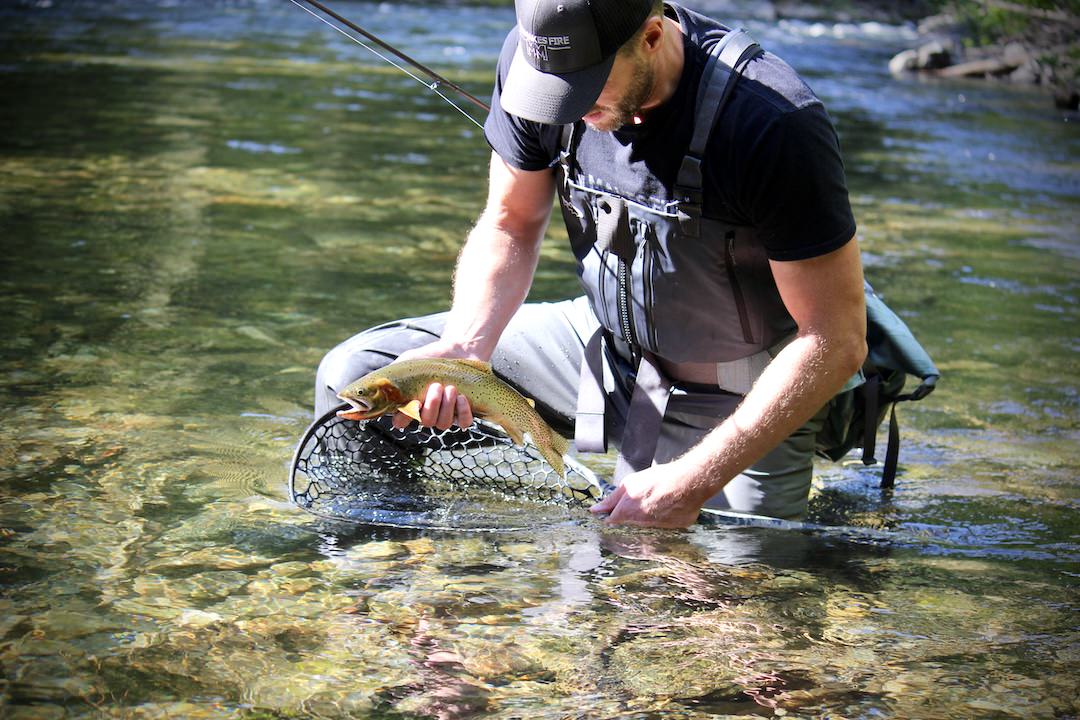
But not all terrain is the same. When I’m fishing a gentle lake shore, I don’t really care about the weight so much. Or if I’m spending most of my time in a boat. However, if I’m scrambling up and down steep banks or clambering over logs, I want lighter wading boots. Plus, lighter wading boots are usually thinner and more streamlined than their more rugged counterparts. This means that I’m just far less likely to catch a toe on a stick or rock and stumble when I wear a trimmer boot. I don’t like to trip, stumble or fall when I’m carrying an expensive fly rod . . . or trying to land the fish of a lifetime.
Any Drawbacks?
The biggest drawback to lightweight wading boots is that they sometimes don’t last quite as long as heavier, very rugged boots. If you’re like me, the tradeoff might be worth it. As I get older and wiser, I’m placing my priority on having a better experience while I’m fishing rather than clunking around in heavy boots that will last a bit longer. I’ve worn several lightweight wading boots over the years, including some I’ve reviewed for Man Makes Fire that are in our guide to the best overall wading boots. So, which lightweight wading boot option is my current favorite? And which boots do I appreciate most and recommend? Here are my favorite lightweight wading boots, as well as the reasons I think they’re great options for anyone trying to find a lightweight boot for fishing:
Patagonia Forra Wading Boots
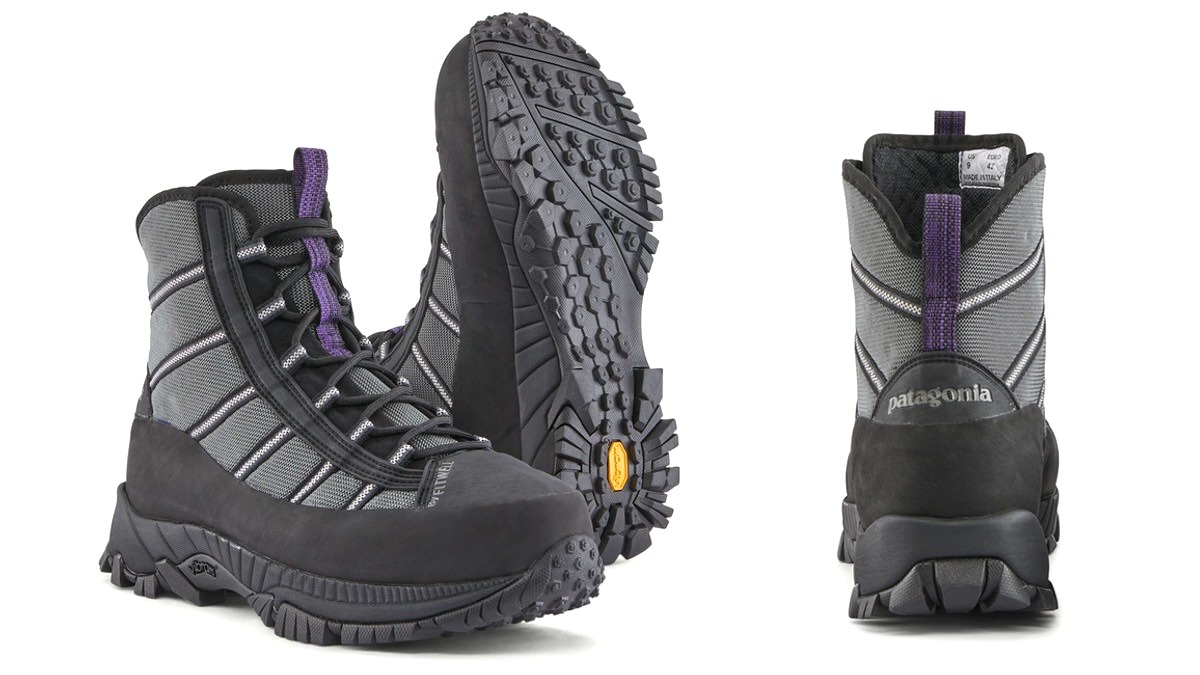
In my experience, the Patagonia Forra Wading Boots are best lightweight wading boots for hiking. I wore them on the St. Joe River in Idaho, which has a lot of slick, round rocks, steep banks, and rugged terrain. They are ridiculously comfortable and deliver an agile, hiking-boot like fit that let me scramble over rocks, climb up and down trails, and step over logs with ease. They’re actually made in Italy by Fitwell for Patagonia. Every Italian boot I’ve ever worn has been fantastic with excellent quality.
Weight per pair: 41 ounces
Despite the light weight, the footbed is super stable. The ankle support is better than I expected, ironically because the upper is relatively thin and flexible. What do I mean? I think because the upper is more flexible than a stiff leather or synthetic, it wraps around my ankle more snugly, resulting in decent support. The rubber soles provide great traction out of the water, but I found them to be about average for rubber-based soles on slick and slimy rocks in the trout rivers I fish in Idaho. If you plan to wade a lot in swift currents on slick rocks, you’ll want to get Patagonia’s Grip Studs Traction Kit. Any drawbacks? Price. The Italian-made Patagonia Forras cost more than most lightweight wading boot competitors. To learn more, read my in-depth Patagonia Forra review for more detail.
Simms Flyweight Wading Boots


Simms actually makes two similar lightweight wading boots, the Flyweight (shown above) and the Flyweight Access (highlighted below). The Flyweight is designed more for hiking durability while the Access is designed for better wet traction. The Flyweight competes very well with the Patagonia Forra. Simms targets it at fly fishers who like to hike far and cover a lot of ground over rough terrain. I like that the synthetic upper has very few seams that can catch on rocks and sticks as you walk, making them more durable for frequent use and long miles.
Weight per pair: 42 ounces
For me, the Flyweight doesn’t fit quite as well nor feel quite as agile as the Patagonia Forra — but it’s very close. If you have a very wide or high-volume foot, I’d recommend the Flyweight over the Forra. The original Flyweight was my go-to boot for walk-and-wade river fishing trips for multiple seasons. I’m still a fan. However, I can’t mention the Flyweight without comparing it to the Flyweight Access. . . .
Simms Flyweight Access Wading Boots
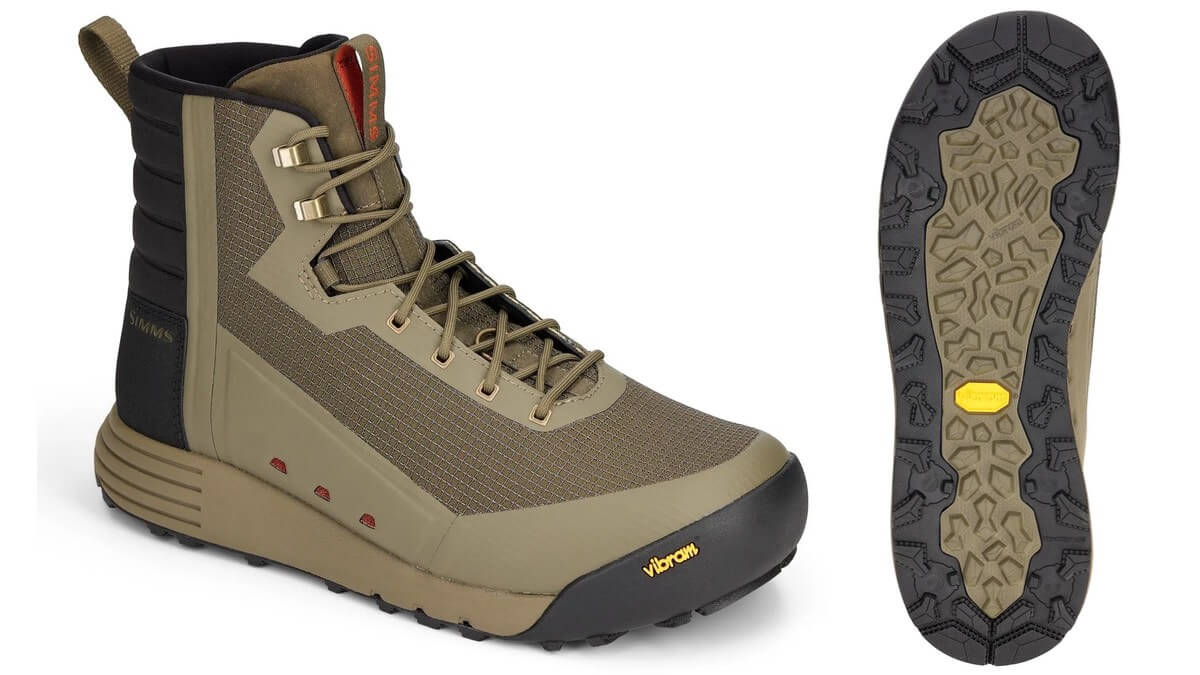
The key thing you need to know about the Simms Flyweight Access is that it has a new sole design that uses two different rubber compounds to create extra grip. The outsole uses a Vibram IdroGrip rubber around the perimeter while the interior uses an even softer Vibram IdroGrip Flex G.O.A.T. which stands for Grip on Auquatic Terrain. While softer rubber soles can improve grip in wet conditions, they tend to wear out fast. By placing the soft Flex material in the center of the Flyweight Access sole, Simms can provide improved grip while protecting the sole from wearing out too fast. If you look at your own boots and shoes, there’s a good chance you’ll be able to see that the edges of your heels and perimeters wear out most quickly. If you’re in a state that requires rubber soled wading boots but you want better in-water traction and want to avoid using studded soles, the Flyweight Access is a good choice.
Weight per pair: 42 ounces
The drawback to the Simms Flyweight Access Wading Boot is that the rubber soles will still wear out faster than boots with harder rubber compounds. Because these might wear out faster than other options, they’re best for those who have larger budgets and are willing to invest in a cushy, comfortable, lightweight boot that favors performance over longevity.
Orvis Pro LT Wading Boots
 The newer Orvis PRO LT Wading Boots include a full-perimeter rand for improved durability.
The next lightweight wading boot you need to know about is the series from Orvis. I wore the first Orvis Ultralight Wading Boot and thought it was one of the most agile boots when it was first introduced. Now, Orvis has expanded the lineup to include the Orvis Pro LT and a new version of its Ultralight Boots. The most important feature of these boots is the lower ankle height, which I love because it helps the boots feel even more agile when I’m scrambling over rocky ground. On the other hand, these boots have some sizing drawbacks for me personally. My street shoe size is a 13.5 or 14, but Orvis’s size 14 is meant for size 13 feet (Orvis sizing is to size up). Consequently, I find them a bit too snug so I can only wear them with stockingfoot waders that have thinner-than-usual stockingfoot booties or if I’m wet wading and wear it with a thin neoprene sock. The newer Orvis Pro LT Wading Boots weigh just 1.5 ounces more than the company’s latest Ultralight option (40.5 ounces), but you get a much more aggressive toe rand and a PU-cast Kurim Mudguard around the lower sides and rear. This will give you better rock-scuffing durability.
Weight per pair: 42 ounces
Of course, if you need additional traction on slick rock, Orvis sells its PosiGrip Screw-in Studs, which you can install into the pre-molded spots on the Michelin Outdoor Extreme rubber outsole.
Korkers Chrome Lite BOA
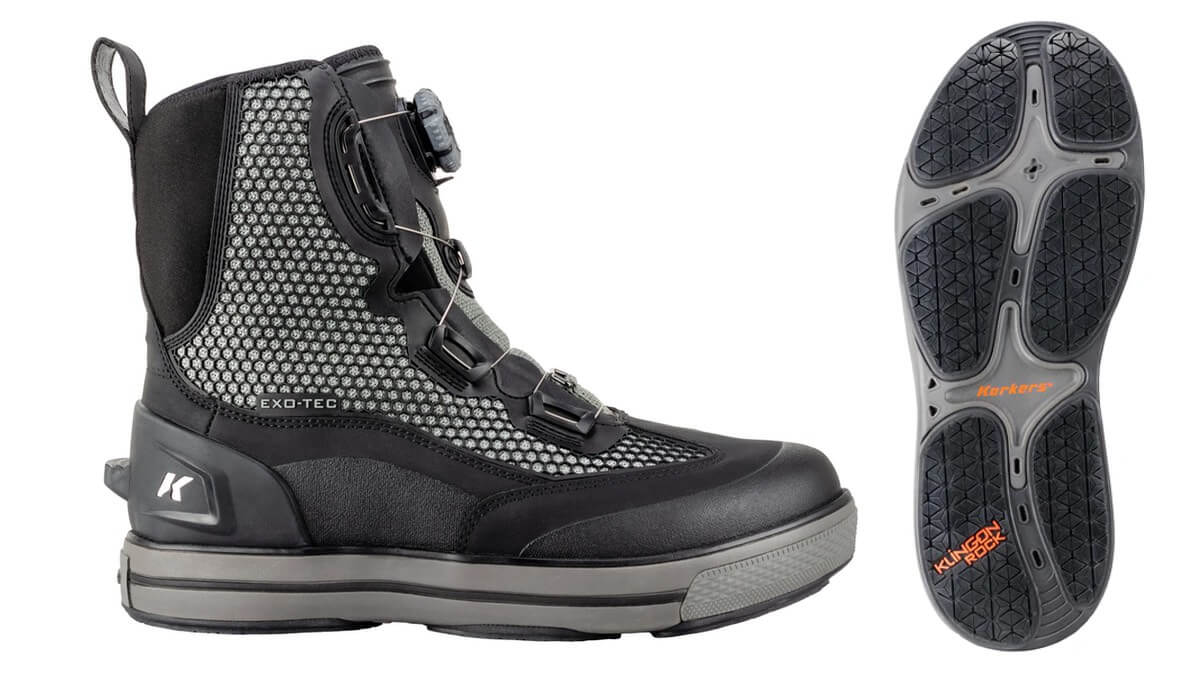
The Korkers Chrome Lite BOA is the lightest wading boot with a BOA lacing system. If you’ve never used BOA laces, they’re fast and easy to use — and I’m a fan. It makes it so easy to tighten and loosen your boots, it’s ridiculous. I’ve used BOA on multiple kinds of footwear over the years, but most importantly I’ve used it on the company’s excellent Devil’s Canyon Wading Boots, which have been one of my all-time favorite wading boots for years. (The Devil’s Canyon boots are only just a couple ounces too heavy to consider lightweight, but I like how they still feel remarkably agile and comfortable.) Back to the Chrome Lite BOAs: Part of the reason they’re so light is that they have a lightweight sole design, which deviates from the OmniTrax interchangeable sole system the company is most known for.
Weight per pair: 42 ounces
If you’re interested in having a sole that you can switch out for different situations, for instance, a rubber sole for hiking and a felt sole for wading, the aforementioned Devil’s Canyon have interchangeable soles, as do the new Korkers Bantam Lite Wading Boots (40 ounces per pair).
Korkers Stealth Sneaker
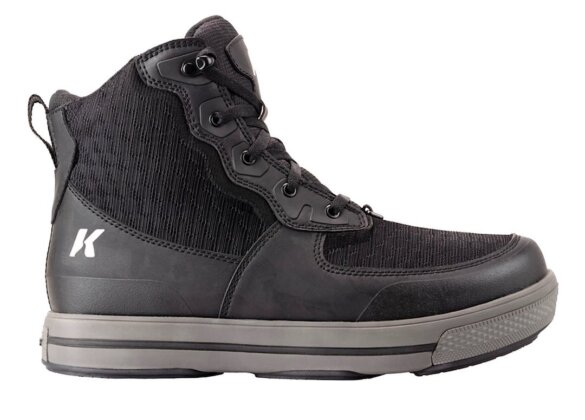 At just 34 ounces, the Korkers Stealth Sneaker is one of the very lightest full-height wading boots available this year.
Korkers introduced its Stealth Sneaker alongside the Chrome Lite BOA. The two new ultralight wading boots share the same rubber sole system, but the Stealth Sneaker has a slightly lighter build with traditional laces.
Weight per pair: 34 ounces
The biggest benefit of the Stealth Sneaker is that it’s the lightest full-height wading boot I’m willing to recommend.
Korkers Bantam Lite
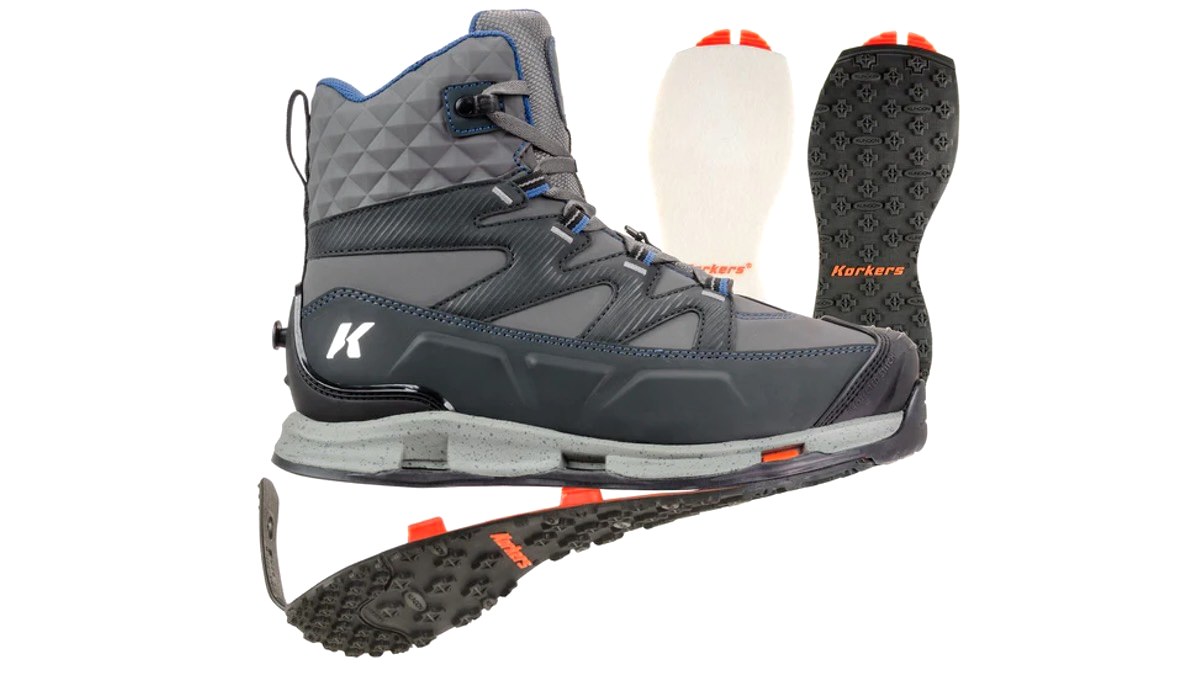
The new Korkers Bantam Lite wading boot uses lightweight hydrophobic materials that don’t absorb much water, keeping them light to wear and fast to dry. They were built with a hiking boot vibe, but they’re not going to truly feel like hiking boots. The OmniTrax Interchangeable Sole System is entirely flat, so you don’t have a heel with a typical hiking boot heel-to-toe drop. The overall fit is large and accommodating, which is great for a wading boot but has little to do with hiking boots. Seriously, if you want something that feels like a hiking boot, you’d be better off with the Patagonia Forra or the Simms Flyweight with the Vibram sole option. That’s not to say the Bantam Lite isn’t a great boot. In addition to the excellent Korkers OmniTrax soles that let you choose your traction, I appreciate the modernized design at a reasonable price point. The rubber toe bumper has protected stitching, and the tall sidewall rand is double-stitched and high enough to protect against most underwater collisions with rocks and debris.
Weight per pair: 45~ ounces depending on sole option
So who is the Bantam Lite for? Because the fit is so accommodating, the Bantam Lite is a good choice for guys with larger, wider, high-volume feet. It’s also good if you plan to wade in cold winter water and a want room for extra warm socks. Last of all, the tall upper gives a little better ankle support than most lightweight options.
Korkers Greenback Wading Boots
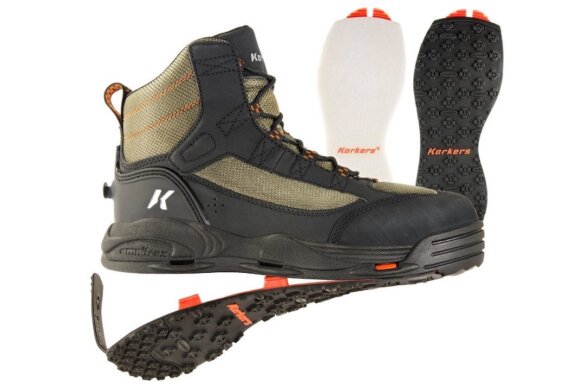 The entry-level Korkers Greenback Wading Boots are surprisingly lightweight with the felt sole option.
The classic Korkers Greenback Wading Boots aren’t usually thought of as an ultralight wading boot, but they’re actually quite light. The Greenbacks are an entry-level wading boot and they have a sort of vague, clunky fit-every-foot design. However, they’re really hard to beat for the entry-level price point and they’re quite comfortable.
Weight per pair: 40 ounces with felt sole option
If you’re a beginner and are on a budget, I recommend the Korkers Greenbacks often.
Great Wet Wading Option: Korkers All Axis Shoe
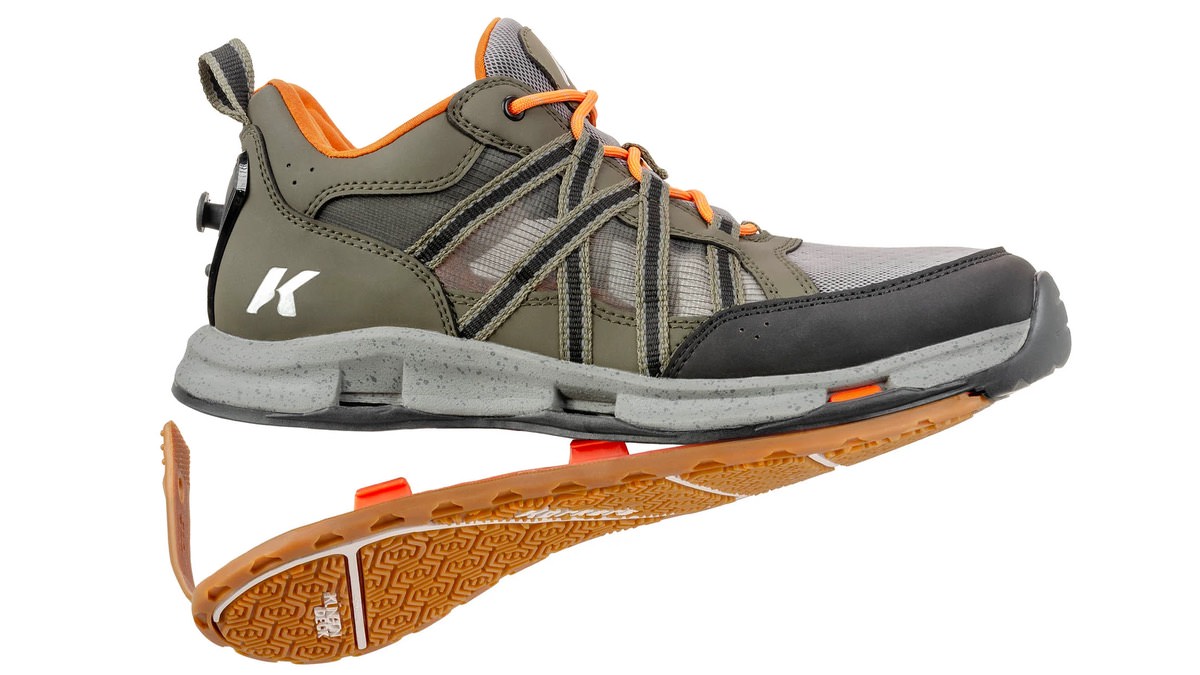
The Korkers All Axis Shoe is my favorite wet-wading shoe. It’s basically an ultralight, meshy water shoe with the Korkers OmniTrax interchangeable sole system. You can wear the All Axis Shoe with regular waders, of course, but the best use is wet wading. I find them to be remarkably agile and stable — and I’m a fan of the low-top design.
Weight per pair: 30 ounces
There is a drawback, though, and that’s the low-top design: small peddles and debris can more easily get around neoprene gravel guards and get inside the shoe. Plus, the fast-draining airy mesh isn’t as rugged as most other wading boot designs. Still, I’m big fan of wearing the All Axis shoe as a water shoe while rafting and during hot summer wading. Read my full All Axis review here for more detail.
Which Lightweight Wading Boots Should You Choose?
If you want a rubber sole and have the budget, hands-down I recommend the Patagonia Forra Wading Boots for their outstanding comfort and excellent support. The overall build quality is fantastic, too. The only drawback is they are only available in a rubber-soled option and do not have a felt-soled option. I like to wear them in my NRS Otter raft for fly fishing rivers, but I can’t add studs for extra traction to them because I don’t want to damage the rubber on my raft. If your state allows felt and you’re willing to fish only single drainages at a time to avoid any chance of transporting invasive species, Simms offers a felt version in its Flyweight series, the new Korker’s Bantam Lites have interchangeable soles, like the affordable Korker’s Greenbacks.