

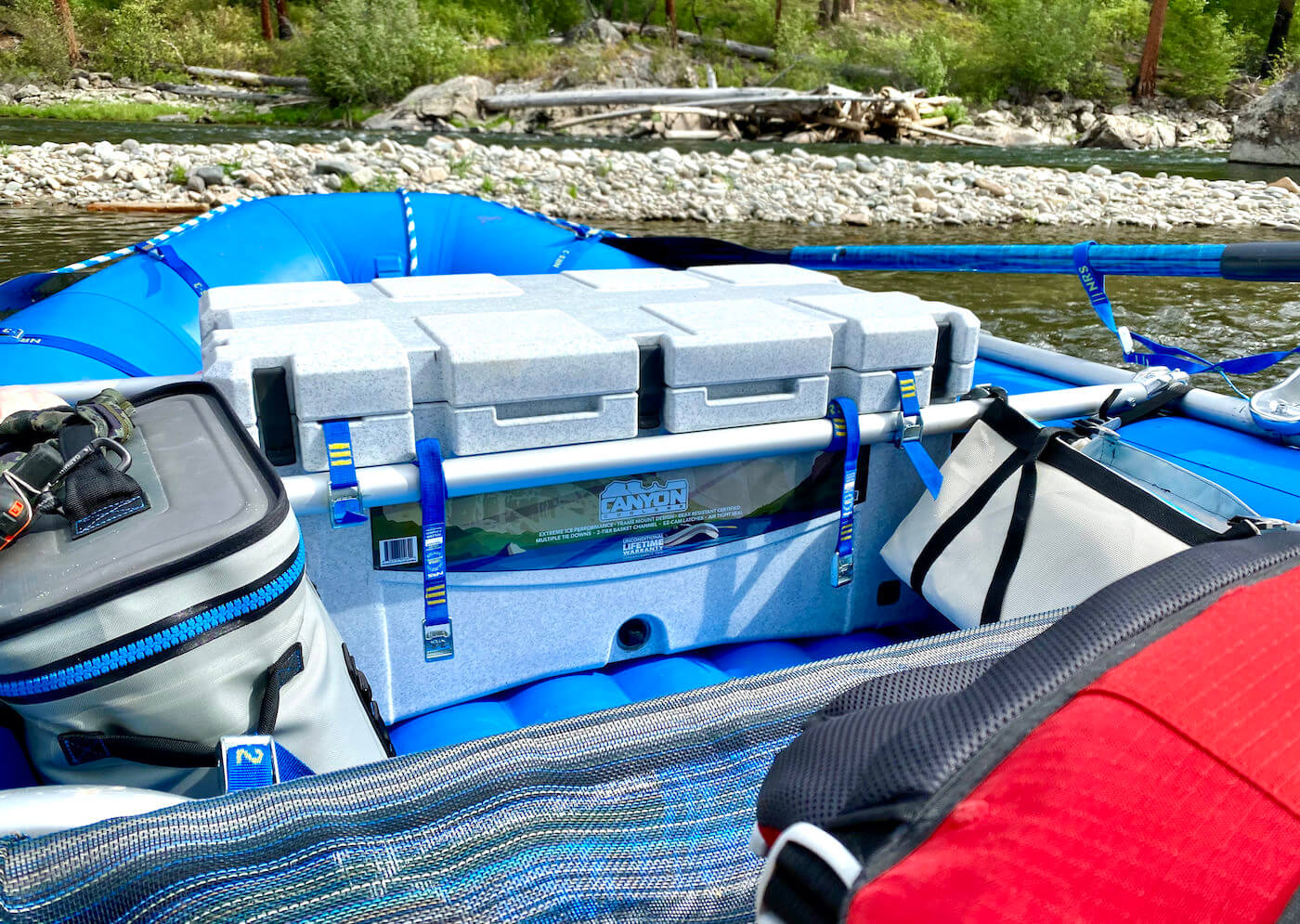
The Canyon Coolers Prospector 103 is a rugged hard cooler designed specifically for whitewater rafting. The Prospector 103’s key feature is a built-in ‘lip’ that lets you drop it into a raft frame without needing brackets or a sling.
To get us a closer look, Canyon Coolers sent Man Makes Fire a review unit. After testing the Prospector 103 on a 7-day whitewater rafting trip on the Middle Fork of the Salmon River in Idaho, this is what we learned:
Canyon Coolers Prospector 103 Review
 The Canyon Coolers Prospector 103 cooler is purpose-built to fit into frames for whitewater rafting.
When I told my rafting buddy I had a new cooler on hand to review on the Middle Fork, his response was instant:
“Is it a Prospector 103?!?”
Not all rafters know about the Prospector 103, of course, but everyone who has seen one instantly recognizes the brilliance of its design — and they remember it.
While you can take most any high-quality, rotomolded cooler whitewater rafting, the Prospector 103 makes rigging your cooler in your raft very easy.
Basically, the Prospector 103 has a top section with an edge that’s wider than the main bottom section, and this molded edge supports the cooler when you drop it in between the crossbars on your raft’s frame.
This is important because it keeps the bottom of the cooler up off of the floor of your raft. The Prospector 103 slips into your raft’s frame a lot like a typical aluminum dry box with welded in brackets.
Secure and Rigged to Flip
 The Prospector 103 includes four built-in strap mounting points for super secure rigging. The 1′ NRS strap holds the cooler to the frame while the NRS loop strap (left) is for securing a pad over the top of the cooler.
For our Middle Fork trip, I took my NRS Otter 150 with the easily customizable NRS frame system.
To secure the Prospector 103 in place, Canyon Coolers designed two sets of two molded strap points on the front and back. They perfectly fit NRS straps, and I used four 1′ straps to secure the cooler to my NRS frame. With these four straps, the Prospector 103 is solid. If you flipped with just these four straps, the Prospector 103 would stay put — and the lid would likely stay shut in all but the most catastrophic situations.
The Canyon Coolers Prospector 103 is easily the best hard cooler for rafting.
Still, you can always throw a couple straps over the top to keep your PBRs extra secure, which is what I did. And, get this, Canyon Coolers has grooves molded into the top and sides that make it easier for you to use straps over the top. In my case, the straps also secured a pad in place on top of the cooler. Because of our configuration for the trip, I sat on the Prospector 103 when rowing. Some people place the cooler up front so passengers can sit on it, often with a Paco Pad strapped to the top of their cooler.
More Raft-Ready Design Features
 The latches on the Prospector 103 are positioned above the built-in frame shelf. Canyon Coolers includes additional strap points at the sides, along with spots for padlocks if you’re in bear country.
You know the Canyon Coolers designers have spent time on the river because the Prospector 103 has even more raft-ready features. In fact, the attention to detail is excellent throughout.
First, Canyon Coolers added two drain plugs — one in front and one on the side. This means you could likely get to a drain plug when your raft is rigged . . . or get to one if the cooler is in the back of your pickup.
Second, Canyon Coolers includes additional strap points on each side of the cooler. This makes it easy to strap gear on either side of the cooler and to your raft frame. I used these side strap points every day on our Middle Fork trip for smaller dry bags.
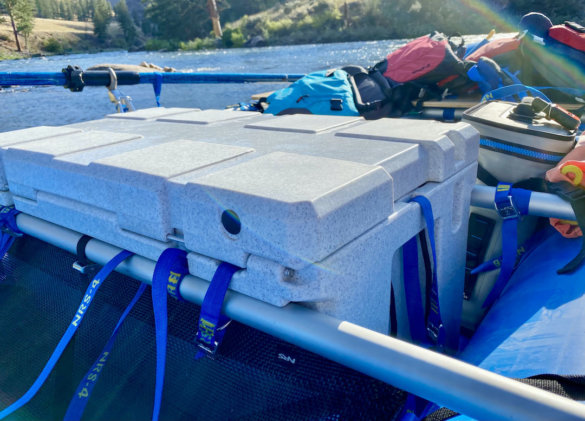 The rear has strap lashing points. The hinge pin is also stout.
Third, Canyon Coolers leaves a portion of the rugged hinge pin exposed at the rear of the cooler to act as yet another strap point if you need it keep a pad in place.
And yet there is one more critical rafting feature: The latches are positioned above the frame in your boat so that you can open your cooler while it’s strapped down on your raft. So cool.
Inside the Prospector 103
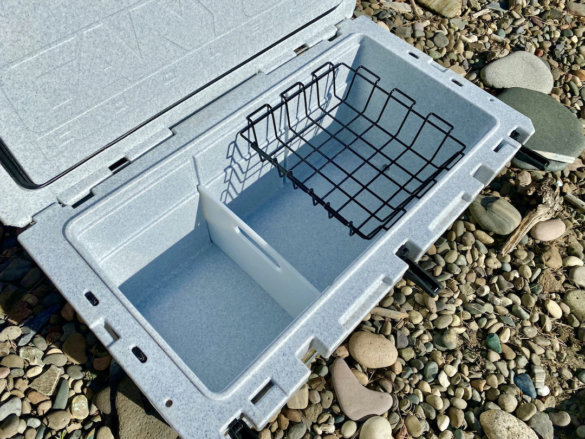 The 103-quart capacity gives you lots of ice and food/beverage options for week-long trips!
Canyon Coolers extends the usability to the inside of the cooler, too. The Canyon Coolers Prospector 103 basket will fit on a low ledge inside the cooler or on a higher ledge. In fact, you can use up to four baskets to help with organization.
Like most high-quality rotomolded coolers, there are two divider slots. The Prospector 103 Divider is a BPA-free, NSF food safe plastic that you can use as a cutting board. It’s also dishwasher safe.
Key Specifications:
Capacity: 103 quarts
Exterior Dimensions: 37.5″ x 21.25″ x 18.5″
Exterior Dimensions of Base: 37″ x 18″
Interior Dimensions: 31″ x 13.5″ x 13.75″
Weight: 39.5 lbs
Ice Retention
Most high-quality rotomolded hard coolers with freezer-style gaskets do well with multi-day ice retention. On our Middle Fork test trip, the Prospector 103 easily held ice for 8 days. In fact, on multiple hot August days, I left the Prospector 103 in the raft in full sun during lunch stops and often at camps in the afternoon.
How did I get such good ice retention? First, I sacrificed a 20-pound bag of ice to “season” the cooler the day before we were set to leave. Basically, if you want ultimate ice retention, all the rotomolded cooler manufacturers recommend that you throw ice in the cooler the day before to help bring down the temperature of the cooler’s interior walls and insulation. That way you won’t waste any ice cooling warm plastic.
The same goes for your contents — start with cold contents (like slowly frozen PBRs!).
For my ice, I decided to freeze a few GSI Outdoors Water Cubes. These are basically typical polyethylene water bags usually used for drinking water while camping. I froze them because they’re square cubes that could maximize ice density. I used two 10-liter versions (which hold about 2.6 gallons each in a 9″ cube) and one 15-liter version which holds a massive 3.9 gallons of water.
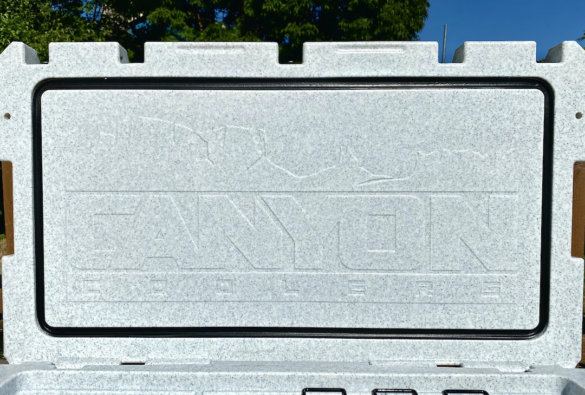 The thick lid is loaded with insulation and uses a high-quality freezer-style gasket.
We had no problem keeping our Prospector 103 cold for the duration of the trip. In fact, on day 5 we started setting a cube out on a camp table at dinner to drink from the ice-cold water.
Meanwhile, most ice retention tests are inherently flawed because none of the cooler manufacturers make the exact same cooler sizes. Still, Canyon Coolers published a head-to-head test against similar sized YETI Tundra coolers. Canyon Coolers came out ahead in those tests. Either way, we don’t believe that ice-retention is the most critical buying decision factor when it comes to choosing a hard cooler. We believe most customer satisfaction will come from buying the right size and shape of cooler that fits your needs best.
Drawbacks
There is only one detail that gives me a very slight pause, and that’s the latches. On an NRS frame system, which has 1 5/8″ diameter crossbars, the latches can be slightly difficult to get a finger under and open. I have relatively big hands and I can do it, but it usually takes me an angle adjustment of my hand to get it right.
Canyon Coolers is aware of this and, consequently, sells a Raft Frame Lift Kit, which the company recommends for rafters using 2″ diameter frames. Rafters using crossbars that are smaller than the NRS cross bars are unlikely to have any issues at all.
However, if you use an NRS frame system like I do, Canyon says it’s OK to drill a small hole in the bottom of your latches to allow you to add a small pull loop with some cord. Doing so won’t void your warranty. I haven’t done it myself, but I can see how and think it’s a great idea.
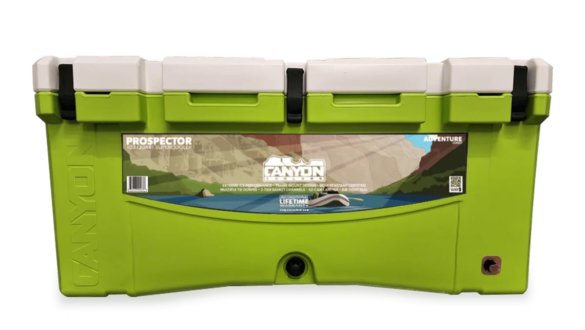 Canyon Coolers currently offers the Prospector 103 in four color choices.
Competitive Alternatives & Options
Of course, you don’t have to have a cooler purpose-built for rafting. You can take most any large, high-quality rotomolded cooler on a 7-day whitewater rafting trip. You’ll likely need to use a strap-based sling, or better yet, the NRS Frame Adjustable Cooler Mounts (which cost about $100~). I’ve used the NRS cooler mounts before and they work great. They effectively stop your hard-sided cooler from any rotational slip if you’re sitting on it, and they let you rig the cooler securely. The downside to using the NRS cooler mounts is the cost.
If you are considering the Prospector 103, here are a few other cooler options you might check out:
YETI Tundra 110 — YETI markets the Tundra 110 as its 7-day whitewater excursion cooler. Its dimensions fit well in most rafts, and overall YETI quality is hard to beat. The Tundra 110 has similar exterior dimensions as the Prospector 103 — they’re both 37.5″ wide but have slightly different heights and depths. The Prospector 103, however, may have more usable interior volume than the YETI 110. Based on their published interior specifications, the YETI has approximately 4,742~ cubic inches of volume while the Prospector has approximately 5,754~ cubic inches. The actual volume can vary a bit based on the interior shapes, which have sidewall tapers, drain tapers, and lid shape considerations. Despite the “110” number in the name, YETI doesn’t publish the actual interior volumes of its hard coolers, so 110 doesn’t necessarily equal 110 quarts — YETI doesn’t use volume as part of its naming style. (If you like math, the Prospector’s rough calculation of 5,754 cubic inches of interior space translates to 99.6 quarts — so very close to Canyon Cooler’s actual 103-quart specification, which would include interior shape tapers.)
Engel 123 Hard Cooler — The Engel 123 high-performance hard cooler holds about 108 quarts, making it slightly larger in interior volume than the Prospector 103. It weighs in at a competitive 42 lbs. The biggest drawback could be its slightly wider 42″ width, which may not fit into your raft and frame as easily as the Prospector 103 or YETI 110.
RTIC 110 QT Hard Cooler — The RTIC 110 QT Hard Cooler boasts 110 quarts of volume in a similar width and overall size as the Prospector 103 and YETI 110. The biggest drawback of the RTIC 110 is its extra weight — it weighs a whopping 53 lbs empty, which is significantly heavier than similarly sized competitive coolers.
Canyon Coolers Navigator PRO150 — While Canyon Coolers makes many other sizes of hard coolers, only the Navigator PRO150 shares a similar rafting-ready design. Like the Prospector 103, the PRO150 has a built-in lip for easy frame drop-in rigging. The key difference is its size — a massive 150 quarts of volume. It’s big enough, by the way, to hold up to four bone-in elk quarters, which makes it a great cooler for hunting guides and outfitters. Despite its large dimensions, it’ll still fit underneath a tonneau cover in a full-size pickup, making it an interesting choice for those who head out on different kinds of week-long+ adventures.
Shop the Prospector 103 at Sportsman’s Warehouse with a FREE Ship-to-Store option!
The Bottom Line
All-in-all, the Canyon Coolers Prospector 103 is easily the best hard cooler for rafting. The exterior design makes it easy to drop into many frames for rafts, and the strap points make it easy to secure. The roomy 103-quart size is near perfect for multi-day trips. Overall quality is excellent, as is overall ice retention and performance. Very highly recommended.
Get the Gear:
Tired of lugging heavy coolers? Check out the new YETI Roadie 48 & 60 — with wheels!
